“Terra Preta“, or “dark earth”, is an Amazonian Indian technology which can vastly improve soil fertility and pull carbon dioxide out of the atmosphere, potentially keeping it out for thousands of years. Biomass – plant and animal waste such as manure, waste wood, and crop leftovers – can be turned into charcoal (or “biochar”) and then buried in agricultural soil, making rich black earth that plants grow very, very well in. Charcoal is extremely porous, and provides a perfect environment for beneficial soil microorganisms that help plants grow. It also holds water, and can greatly help crops to survive drought conditions.
Biochar can be used to pull carbon dioxide out of the atmosphere and potentially reverse global warming (if it were used on a wide enough scale). As we know from archaeological carbon-14 dating processes, charcoal lasts a long time; (terra preta was actually “discovered” by archaeologists trying to figure out how the Amazon, with its depleted tropical soil, could have supported the large urban population for which they were finding evidence). Plants pull CO2, carbon dioxide, out of the air to grow – this is where the vast majority of their mass comes from. If that mass is broken down naturally by the composting process, the carbon stays out of the atmosphere for 6-12 years on average. Char it, though, and it’ll be in the ground for hundreds, if not thousands, of years. (Some patches of Terra Preta soil in the Amazon are around 2000 years old.) What’s more, you can weigh exactly how much you’re sequestering – just put it on a scale. Theoretically, this could eventually work into carbon trading schemes.
Photosynthesis, at its most basic, is the process where plants use sunlight to take in carbon dioxide, use the carbon for cell building blocks, and give off oxygen. When it is charred, or burned without access to oxygen, the water vapor and various flammable gases, primarily methane and hydrogen, are driven off. The gases can be collected for cooking gas or electricity generation, or in lower tech production directed below the charcoal container to feed the burn. A company called Epidra is making char, hydrogen, and biodiesel simultaneously – see this article for a good overview on biochar and modern usage.
Charcoal appears to provide a medium which facilitates the transfer of minerals from soils to plants; therefore it is better used in conjunction with mineral fertilizers and compost. Essentially, it provides habitat for symbiotic organisms that help plant roots to grow, and acts as a buffer for soil moisture; it is not a fertilizer but a facilitator. Liquid fertilizers can be applied to the char before it is mixed into soil; an Indian researcher, Dr. Sai Bhaskar Reddy Nakka, has been experimenting with using clay pots full of charcoal as urinals in a boys’ school in India; when the pots start to smell, after 10 days or so, the saturated charcoal is removed and then mixed into potting, bringing a strong dose of easily accessible nitrogen to plants. Photos from the trial showed a much darker, healthier green leaves on the treated plants than on the control sample.
Completely untested personal theory, but I suspect that applying a liquid mycorrhizal rooting enhancer (like Mycogrow, for example) to charcoal would give very nice results as well.
For a home gardener, you could make your own charcoal or buy barbecue charcoal made from tree trimmings – i.e., the natural stuff, not the briquets. The easiest way to make charcoal, though it won’t be burned entirely through, is to place a metal garbage bin full of yard waste upside down on bonfire coals and leave it 24 hours, then pore water over it to make sure no coals survive. Crush the charcoal down to a powder and add it to your garden beds, potting soil, or compost bin.
Anyway, some links:
Watch this first (3 minutes):
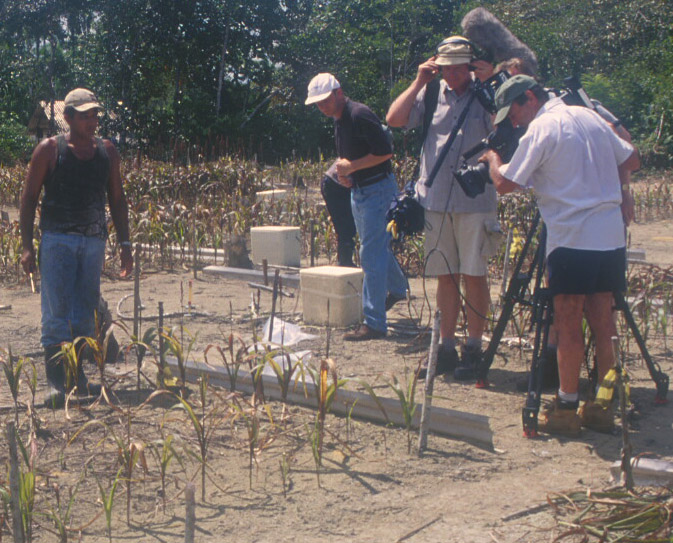
Click on the image for a film section in English
 |
 |
Treehugger.com’s overview. Lots of links in the comments section, too.
Biochar.org has a bit on simple charcoal making.
Terra Preta on Bioenergylists – big clearing house of information, lots of links on how to make charcoal. There’s also a different section on gasification, which aims at producing burnable gases from biomass primarily but gets char as a side product.
Biochar International – very good summary of what Terra Preta does on this page
Terra Preta – Science forums – nice active forums talking about terra preta
Note: Terra Preta has become a big interest of mine and something that people really need to know more about (especially my Dad, who’s the main person I’m writing this summary for since he works on environmental projects around Africa). Feel free to link to this post!
Update, Feb 12 2009: There’s now a book on biochar, “Biochar for Environmental Management”, available at http://www.earthscan.co.uk/?tabid=49381 .

Pingback: Terra Preta in the news - Page 8 - Science Forums
Erich J. Knight
11 Jul 2008Thanks Kira for this great post, you pretty much covered the most important aspects and links.
I hope you will come to share my passion in getting the word out on the wonderful solutions provided by TP soils.
I’m sort of the TP list cub reporter, most all my list postings, under shengar@aol.com, are news items, collaborative work, lobbying efforts with government, writers and journals.
Bellow are my collected stories and links that I promiscuously post to anyone who has an iron in this fire.
Thanks for your interest
Cheers,
Erich
This technology represents the most comprehensive, low cost, and productive approach to long term stewardship and sustainability.
Terra Preta Soils a process for Carbon Negative Bio fuels, massive Carbon sequestration, 10X Lower CH4 & N2O soil emissions, and 3X Fertility Too.
Indeed, Dr. James Hansen, NASA’s top Atmospheric authority, is now placing it in the center stage of pro-active solutions for the climate crisis.
http://arxiv.org/ftp/arxiv/papers/0804/0804.1126.pdf
UN Climate Change Conference: Biochar present at the Bali Conference
http://terrapreta.bioenergylists.org/steinerbalinov2107
SCIAM Article May 15 07;
http://www.sciam.com/article.cfm?articleID=5670236C-E7F2-99DF-3E2163B9FB144E40
After many years of reviewing solutions to anthropogenic global warming (AGW) I believe this technology can manage Carbon for the greatest collective benefit at the lowest economic price, on vast scales. It just needs to be seen by ethical globally minded companies.
Could you please consider looking for a champion for this orphaned Terra Preta Carbon Soil Technology.
The main hurtle now is to change the current perspective held by the IPCC that the soil carbon cycle is a wash, to one in which soil can be used as a massive and ubiquitous Carbon sink via Charcoal. Below are the first concrete steps in that direction;
S.1884 – The Salazar Harvesting Energy Act of 2007
A Summary of Biochar Provisions in S.1884:
Carbon-Negative Biomass Energy and Soil Quality Initiative
for the 2007 Farm Bill
http://www.biochar-international.org/newinformationevents/newlegislation.html
Bolstering Biomass and Biochar development: In the 2007 Farm Bill, Senator Salazar was able to include $500 million for biomass research and development and for competitive grants to develop the technologies and processes necessary for the commercial production of biofuels and bio-based products. Biomass is an organic material, usually referring to plant matter or animal waste. Using biomass for energy can reduce waste and air pollution. Biochar is a byproduct of producing energy from biomass. As a soil treatment, it enhances the ability of soil to capture and retain carbon dioxide.
( Update; In conference the $500 M was cut to $3M….:( 🙁 🙁 )
Erich J. Knight
11 Jul 2008Thanks Kira for this great post, you pretty much covered the most important aspects and links.
I hope you will come to share my passion in getting the word out on the wonderful solutions provided by TP soils.
I’m sort of the TP list cub reporter, most all my list postings, under shengar@aol.com, are news items, collaborative work, lobbying efforts with government, writers and journals.
Bellow are my collected stories and links that I promiscuously post to anyone who has an iron in this fire.
Thanks for your interest
Cheers,
Erich
This technology represents the most comprehensive, low cost, and productive approach to long term stewardship and sustainability.
Terra Preta Soils a process for Carbon Negative Bio fuels, massive Carbon sequestration, 10X Lower CH4 & N2O soil emissions, and 3X Fertility Too.
Indeed, Dr. James Hansen, NASA’s top Atmospheric authority, is now placing it in the center stage of pro-active solutions for the climate crisis.
http://arxiv.org/ftp/arxiv/papers/0804/0804.1126.pdf
UN Climate Change Conference: Biochar present at the Bali Conference
http://terrapreta.bioenergylists.org/steinerbalinov2107
SCIAM Article May 15 07;
http://www.sciam.com/article.cfm?articleID=5670236C-E7F2-99DF-3E2163B9FB144E40
After many years of reviewing solutions to anthropogenic global warming (AGW) I believe this technology can manage Carbon for the greatest collective benefit at the lowest economic price, on vast scales. It just needs to be seen by ethical globally minded companies.
Could you please consider looking for a champion for this orphaned Terra Preta Carbon Soil Technology.
The main hurtle now is to change the current perspective held by the IPCC that the soil carbon cycle is a wash, to one in which soil can be used as a massive and ubiquitous Carbon sink via Charcoal. Below are the first concrete steps in that direction;
S.1884 – The Salazar Harvesting Energy Act of 2007
A Summary of Biochar Provisions in S.1884:
Carbon-Negative Biomass Energy and Soil Quality Initiative
for the 2007 Farm Bill
http://www.biochar-international.org/newinformationevents/newlegislation.html
Bolstering Biomass and Biochar development: In the 2007 Farm Bill, Senator Salazar was able to include $500 million for biomass research and development and for competitive grants to develop the technologies and processes necessary for the commercial production of biofuels and bio-based products. Biomass is an organic material, usually referring to plant matter or animal waste. Using biomass for energy can reduce waste and air pollution. Biochar is a byproduct of producing energy from biomass. As a soil treatment, it enhances the ability of soil to capture and retain carbon dioxide.
( Update; In conference the $500 M was cut to $3M….:( 🙁 🙁 )
Erich J. Knight
11 Jul 2008The active discussion group has been moved to a yahoo group
http://tech.groups.yahoo.com/group/biochar/?yguid=122501696
Erich J. Knight
11 Jul 2008The active discussion group has been moved to a yahoo group
http://tech.groups.yahoo.com/group/biochar/?yguid=122501696
Cristin Speak
29 Jan 2010Hi. Very interesting Blog. Not really what i have searched over Google, but thanks for the information.
Cristin Speak
29 Jan 2010Hi. Very interesting Blog. Not really what i have searched over Google, but thanks for the information.
Diaper Cake Directions
3 Feb 2010The information presented is top notch. I’ve been doing some research on the topic and this post answered several questions.
Diaper Cake Directions
3 Feb 2010The information presented is top notch. I’ve been doing some research on the topic and this post answered several questions.
John Natural
3 Feb 2010Great site, exactly what I was looking for, I can’t get your RSS feed to work right in google chrome though, is it on my end?
John Natural
3 Feb 2010Great site, exactly what I was looking for, I can’t get your RSS feed to work right in google chrome though, is it on my end?